

As businesses scale, one of the most strategic decisions founders grapple with is collaboration versus control. The business partner vs employee debate is not just operational; it impacts long-term growth, flexibility and decision-making.
According to the Society for Human Resource Management (SHRM), The average cost per hire has jumped to nearly $4,700, and some employers estimate the total cost of filling a single role can be three to four times that position’s annual salary. A $60,000 job could translate to a possible spend of $180,000 or more.
PrtnerUp is for people looking for business partners based on meaningful relationships between people aligned by goals and intent. But before deciding, it is important to understand the strategic implications of both paths.
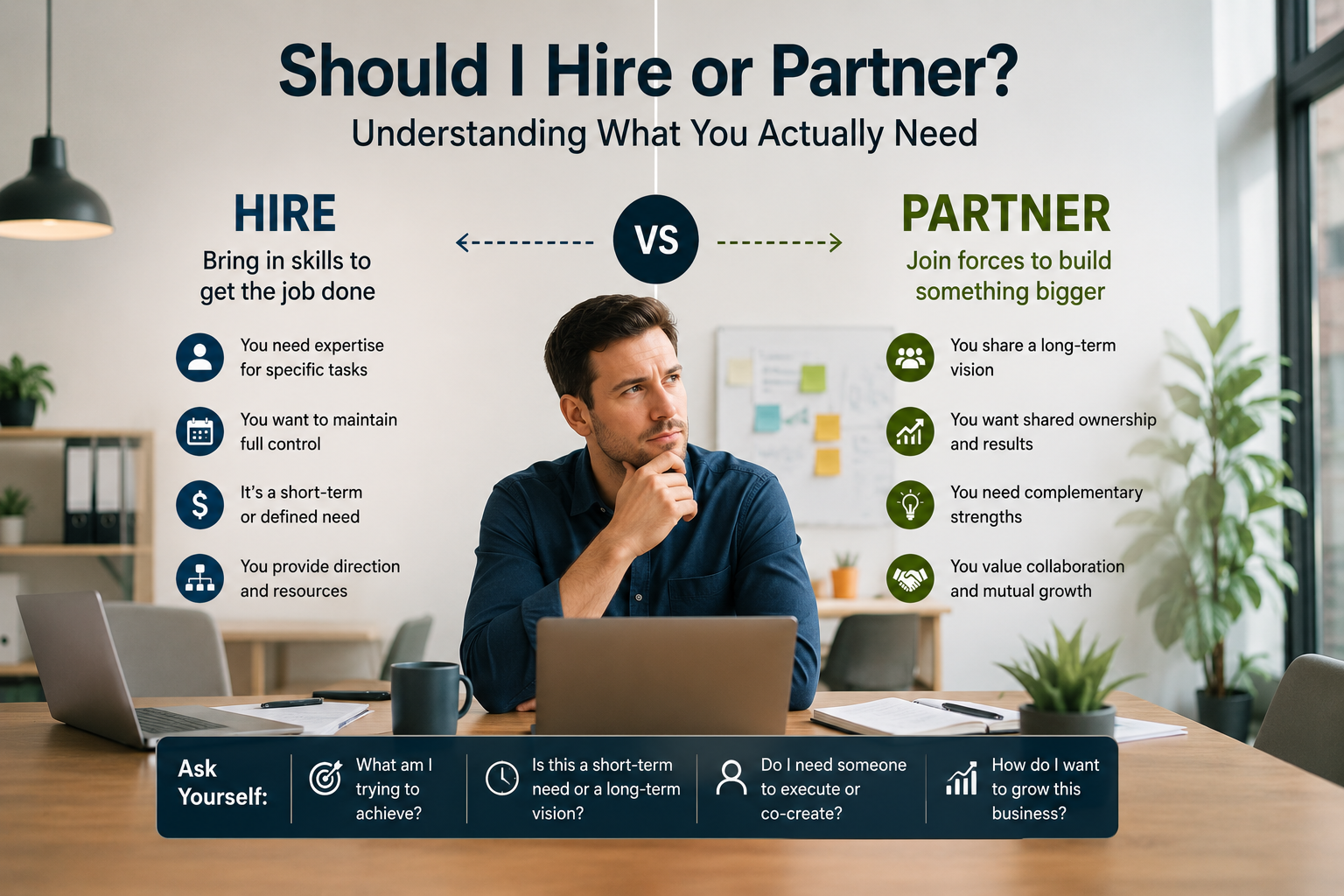
Should I Hire or Partner? Understanding What You Actually Need
Before reaching a conclusion on should I hire or partner, the more productive first step is an honest diagnosis of what the business requires. At its core, hiring is a decision about capacity – paying for work within a defined scope. Business partnership, on the other hand, is a very different proposition: shared ownership, shared risk and shared reward. The right partner brings strategic contribution, subject matter depth or capital that changes what the business can do. When you mix the two, you get costly misalignments: treating a partner like an employee or expecting a hire to have the ownership mentality of a partner.
Breaking Down the Real Difference Between Hiring and Equity Partnership
It is useful to compare hiring vs equity partnerships across the dimensions that most directly affect business performance and owner well-being.
| Dimension | Hiring an Employee | Equity Partnership |
|---|---|---|
| Upfront Cost | Recruitment fees, onboarding, salary from day one | No salary obligation; partner shares risk and reward |
| Alignment of Incentives | Salary-driven, outcome alignment requires careful management | Inherently aligned, a partner's gain tied directly to business success |
| Expertise Contribution | Defined role; skills in area of the job | Strategic depth; subject matter expertise applied across the business |
| Risk Shared | No, employee does not absorb business downside | Yes, partner shares both upside and downside |
| Ownership Mindset | Rarely present without additional incentive structures | Intrinsic: the partner has genuine stake in outcomes |
The Real Advantages of Business Partnership
The financial comparison tells part of the story. The deeper advantages of business partnership lie in what it makes structurally possible : capabilities, connections, and strategic capacity that salary-based arrangements rarely replicate.
Genuine skin in the game. A partner whose compensation is tied to outcomes brings an engagement quality that is structurally different from a salaried employee; decisions are made with ownership-level care.
Complementary capability without fixed overhead. A well-structured partnership can bring deep expertise without the salary burden from day one, especially valuable for growth-stage businesses managing cash flow carefully.
Expanded networks and market access. An experienced partner often brings established industry relationships and market knowledge that would take years to build internally.
When It’s The Right Call For Hiring
Honestly, hiring is sometimes absolutely the right thing to do. It tends to work best when the work is clearly operational and repeatable, when management oversight is available, or when the need is truly short-term or project-based. In those cases, hiring works well for the business, with clearly defined scope and clear reporting lines. It’s never a question of which option is outright better; rather, it’s about which one is appropriate for the specific need at this moment in time.
Bring in A Partner Vs Hire A Consultant
Another common consideration is bringing in a partner versus hiring a consultant.
- Consultants offer specialized expertise for a defined period without long-term commitment
- Partners contribute to ongoing strategy and share responsibility for outcomes
Consultants are usually better suited for short-term problem-solving, whereas partners are more in line with long-term growth initiatives.
Finding the Right Partner Starts with the Right Platform
Once the decision to go for a partnership has been made, the practical challenge is to find the right person. Knowing how to find a business partner or investor who is genuinely aligned with your goals requires a purpose-built environment where every member is there for the same reason. General professional networks and freelance platforms have different use cases. Business partner vs employee is a question of a specific need, a person with the right expertise actively seeking a long term business relationship, searchable by industry, skill, and location.

Grow with the Right Business Connections Through PrtnerUp
The choice of hire versus partner deserves more than a knee-jerk reaction. In many cases, a partnership is the most logical business structure when strategic expertise, shared ownership, and a long-term commitment are needed to fuel growth. PrtnerUp connects business owners, subject matter experts, and investors ready to build something meaningful, with purpose and precision.
Find Your Business Partner on PrtnerUp →
FREQUENTLY ASKED QUESTIONS
What is the difference in business partner vs employee decisions?
A partner has ownership and decision-making, while an employee is an individual who works in the execution of duties within your defined responsibilities and direction.
When should I consider looking for business partners?
Consider it when you need strategic collaboration, complementary skills and shared accountability for long-term growth.
How do I decide should I hire or partner?
Decide if you require operational execution or strategic input. And this clarity usually tells us what the right choice is.
What are the key advantages of a business partnership?
They include shared risk, wider expertise, collaboration in decision making and a stronger strategic direction.
Is hiring vs equity partnership more cost-effective?
Depends on your structure. Hiring comes with fixed costs. Partnerships involve shared returns and long-term commitment.