

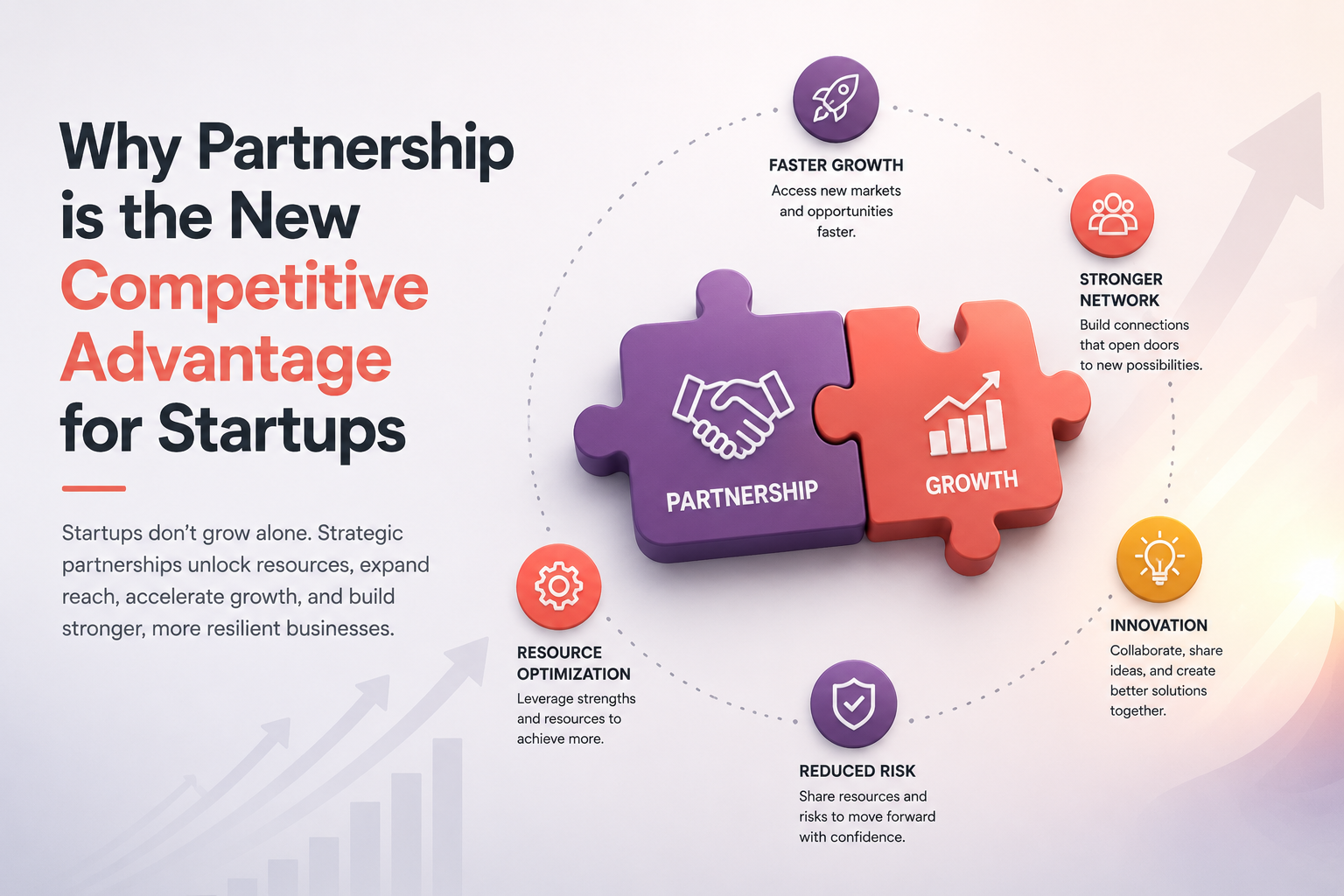
The startup world has long lionized the lone founder, the visionary who builds an empire from nothing but grit and a remarkable idea. As compelling as that story is, it can obscure a more accurate view of how early-stage businesses really grow. The hardest competitive advantage to replicate is not a technical or financial one. More often, it's relational. Knowing why startups need partnership is not just an academic exercise; it is a strategic imperative for any founder serious about sustainable growth. PrtnerUp was founded on just this conviction. Connecting business owners to the right subject matter experts and investors creates a foundation that no solo effort can reliably replicate.
The European Innovation Council’s Corporate Partnership Programme has facilitated over 1,500 startup-corporate engagements across Europe since 2017, with more than 120 major corporations involved. Over 100 business agreements have been confirmed, and the program has a 92% satisfaction rate among participating companies.
That number is clear. Startup partnership is not a feel-good, soft concept. It is a measurable driver of outcomes, increasingly recognized by institutions and policymakers as foundational to economic growth.
What Does Real Partnership Actually Look Like for a Startup?
Many founders mistake partnership for outsourcing or hiring. They are not the same. A freelancer completes a job. A true partner cares about the outcome. The true startup innovation strategy recognizes that the right partner invests in the business’s direction, not just in their skill set.
In reality, there are a few common forms of meaningful startup partnership:
- Subject matter expert partnerships: A founder with great product instincts partners with an expert in finance, marketing, legal, or operations—filling in the gaps experience alone cannot bridge.
- Investor relationships: Cash is king, but it has to be value-added, not just a check. The most active investors in the companies they back are also the best early investors.
- Co-founder arrangements: Research has shown that companies with co-founders consistently outperform those with a single founder. Complementary expertise at the founding level reduces blind spots from day one.
- Strategic advisor connections: Experienced professionals who provide guidance and networks—often more valuable to an early-stage startup than any one tactical decision.
Beyond the Obvious Benefits of Business Partnership
The most frequently mentioned benefit of partnership is access to expertise—and it is a real benefit. But it’s only the beginning of what a well-matched partnership can deliver. The deeper benefits of partnership in business compound over time in ways that are more difficult to quantify but no less tangible.
| Growth Factor | Going It Alone | With the Right Partner |
|---|---|---|
| Expertise gaps | Filled slowly through trial and error | Filled immediately through targeted partnership |
| Decision-making quality | Limited to one perspective | Stress-tested against complementary viewpoints |
| Network reach | Grows linearly with the founder | Expands through shared relationships and referrals |
| Resilience under pressure | Single point of failure | Distributed responsibility and accountability |
| Investor confidence | Harder to signal team depth | Demonstrably stronger team signals lower risk |
And that’s why business growth consulting pros always mention team makeup and quality of partnerships as the top factors in whether an early-stage business sustains momentum or grinds to a halt—often before the product even becomes the differentiator.
How Do Startups Actually Grow Fast? It rarely happens in isolation.
As analysts examine how startups grow fast, one common pattern emerges: businesses that scale with meaningful speed almost always have a network advantage. It’s not just that they work harder than their competition; they have better information, better support systems, and more resources. Speed of execution increases when the right expertise already sits in the room.
Historically, the problem has been structural: business owners and subject matter experts struggled to find each other without an existing network or a costly intermediary. That friction slowed partnership even before it could begin.
What Separates a Good Partnership From a Great One
It’s not enough to know the value of partnership. How startups partner effectively depends on a specific set of conditions being present, conditions that do not arise automatically just because two parties have agreed to work together.
- Set the purpose early: Both parties need to know what success looks like, both commercially and relationally, before any formal arrangement is put in place.
- Mutual benefit, really understood: The most lasting partnerships are those where both sides achieve their goals, not just one side.
- A communication rhythm that is agreed upon, not assumed: How often will the partners review progress? How is disagreement expressed? Most founders underestimate the importance of details.
- Not only matching skills but also matching values: Two parties can be technically complementary and still be fundamentally misaligned in their operations. It is not only a question of professional compatibility.
Where Do You Find the Right Partner?
Even founders who subscribe to the principles of startup growth partnership often find themselves asking the practical question, "Where do you find the right person?" Personal networks have a restricted size. Freelance platforms are about getting the short-term job done. Professional associations can be slow and location-dependent.
With a dedicated matching platform, the game is different. When the platform is designed with a long-term view, and business owners and subject matter experts actively seek long-term partnerships, the quality and efficiency of connections increases dramatically. Filtering by industry, skill, location, and type of relationship desired takes away a lot of the friction that can make starting a partnership daunting.
Fast Growth Means Little Without Long-Term Stability
Much of the popular discourse about startup innovation strategy revolves around speed: fast iteration, fast hiring, and fast pivots. Speed is good, but pace alone is not a strategy. The startups that make it forge relationships that withstand stress, disagreements, and uncertainty. That’s why startups need partnerships, not as a shortcut to growth, but as a more stable, honest, and sustainable foundation for it.

Ready to Build a Partnership That Actually Lasts? Join PrtnerUp.
PrtnerUp is a platform connecting business owners, subject matter experts, and investors who are serious about long-term partnerships, not short-term transactions. No commissions, no hidden charges, and no charge for basic membership.
Frequently Asked Questions
What is a startup partnership, and why does it matter?
Startup partnership means working with people like experts, investors, or co-founders who share the results. It matters because complementary expertise speeds growth and eliminates expensive blind spots.
How do I know if a potential business partner is the right fit?
Assess shared values, complementary skills, and communication styles. A good partner is someone who is aligned with your long term goals, not just the immediate task.
Can startup growth partnerships work across different industries?
Yes, it can. Industry knowledge often translates across industries. Remote partnership has also expanded the pool of possible partners beyond geographic limitations.
What is the difference between a partner and a freelancer for a startup?
A freelancer is doing a particular job. A partner is dedicated to common results. The difference matters in accountability, longevity, and the depth of value each relationship offers.
How can a startup find subject matter experts to partner with?
The most direct route to well-matched subject matter experts is through dedicated matching platforms—designed for long-term business partnerships, not short-term gigs.